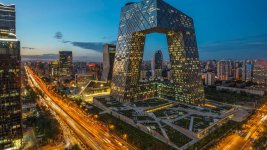
Half of the top 20 science cities are now in China — and regional city growth is the key

Beijingwalker

VIP Member
Joined
Nov 4, 2011
Messages
92,149
Reaction score
113,015
Reputation
2,139.1
Country of Origin
Country of Residence
NATURE INDEX20 November 2024

Half of the top 20 science cities are now in China — and regional city growth is the key​

The country’s research progress means its cities might lead in all Nature Index subjects within a decade.
By Simon Baker

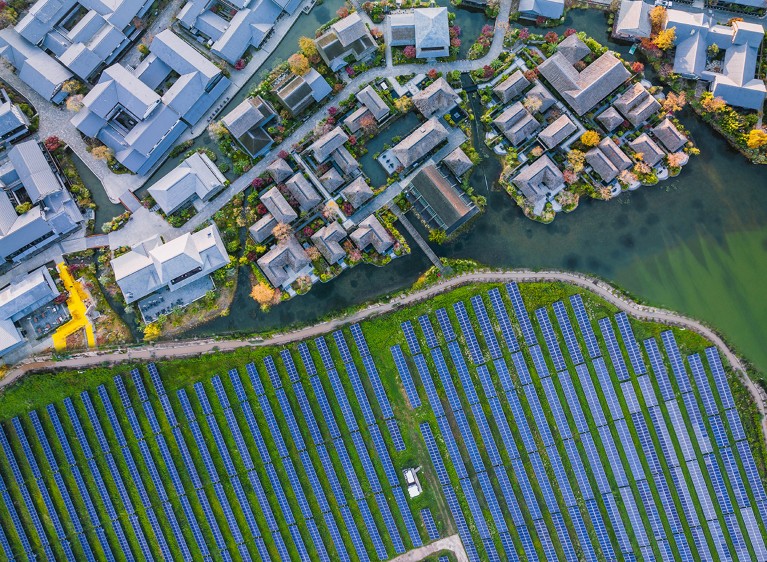
Aerial view of buildings in the top half of the image, and solar panels in the bottom half.

China’s cities are playing a key role in the development of specialist technologies such as solar energy.Credit: Yaorusheng/Getty

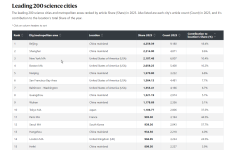
Many of the patterns evident in the data for this year’s Nature Index Science Cities supplement will be familiar to watchers of global science trends over the past decade. China’s research output in the journals tracked by the Nature Index continues to grow strongly, demonstrated by Beijing extending its lead at the summit of the science cities ranking to almost double the Share of the second-placed city. The fact that this second place is now taken by Shanghai, pushing New York into third, only reinforces this trajectory.

Perhaps a more interesting development in the science cities data this year is the clear emergence of China’s provincial capitals. From Chengdu in the west, to Hefei in the east, these cities — lesser known in the West — are now rubbing shoulders in the top 30 with long-established scientific centres in Europe and North America.

The rise of these locations as globally competitive centres for research is as much due to economics and politics as it is science, as China seeks to spread the impact of its knowledge and innovation far and wide. Many of these rapidly developing cities are playing a specialist role in key technology areas such as electric vehicles and solar energy. And their local goals are very much aligned to national strategies to bolster the country’s economic self-sufficiency, such as ‘Made in China 2025’, a policy designed to shift the country towards knowledge-driven high-tech industries.

Even in the health sciences, an area where Chinese cities still lag behind their Western counterparts, there is evident progress. Within a decade, there is every chance that the leading Science Cities in this field — currently dominated by the dense academic–health-care–industry networks built up over many years in areas such as Boston or London — might be in China, too.

We are pleased to acknowledge the financial support of the Beijing Municipal Science & Technology Commission, Administrative Commission of Zhongguancun Science Park in producing this supplement. As always, Nature retains sole responsibility for all editorial content.
 
Great accomplishment. Can China compete with Silicon Valley or has its alternative?
 
China’s regional cities are now major players in world science
NATURE INDEX
20 November 2024

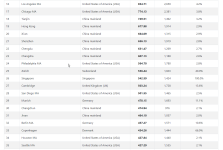
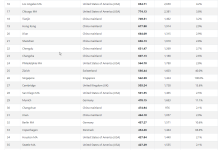
As Chinese research goes from strength to strength, it is natural that the country’s biggest and most economically developed urban areas, such as Beijing and Shanghai, would become superstar science cities; as China gets richer, more educated and more technologically sophisticated, the megacities drive further progress. What might be more surprising is that some of China’s smaller provincial capitals are becoming globally significant, also ranking among the Nature Index top 20. Nanjing (5th), Wuhan (9th), Hangzhou (13th), Hefei (15th) and Xi’an (20th) are all examples, inhabiting ranking territory similar to major global cities, such as Tokyo (10th), Paris (11th), Seoul (12th), London (14th) and Chicago (17th). Furthermore, the data indicate that these provincial cities — each anchoring regions as large and as wealthy, in relative terms, as a European country — are among those seeing the fastest-rising research output in the Nature Index. These trends reveal that as China’s government places science and innovation at the core of its economic strategy, such cities and regions are playing a key role in cultivating excellence and, as a result, a bid for sustainable, technologically driven growth.

Economic imperative

China’s emphasis on scientific progress over the past decade is not just motivated by the intrinsic value of science; rather, research and innovation are seen as upstream of economic growth, more broadly. Science mega-structures, such as the Five-hundred-meter Aperture Spherical Radio Telescope (FAST) in Guizhou province, or the Kunming Institute of Botany, housing Asia’s largest seed bank, in Yunnan, are constructed with both economic growth and scientific excellence in mind. The hope is that nationally funded institutes and research labs in faraway places can spark new industries, ideas and innovations that are then embedded in those regions. Huge regional investments based on emerging technologies, such as a 3.5-gigawatt solar panel field in Xinjiang, should be seen as part of the same process.

This approach of sparking economic growth through regional investment can be especially important at times of instability. As the global financial crisis hit China around 2008, the country invested heavily in infrastructure such as the high-speed rail network that now crisscrosses the country. As China experiences another bout of economic indigestion — by trying to move away from an economy driven by the value of real estate towards one driven by sustainable growth — the country’s leadership has decided that investing in science and technology is central to creating new forms of urban development. Indeed, as China faces an unequal, two-tier economy, with coastal provinces having incomes much higher than interior provinces, it has become politically essential to balance the country’s wealth, lest they experience some Chinese version of the populism that is gripping many Western societies. China’s leaders are well aware of the political problems that can be caused by regional and class inequality, and by assigning key industries of the future, such as green energy or electric cars, to different cities and provinces, science funding becomes a tool of much broader objectives of social equality and stability and the upskilling of a society.

Star student

When China’s president, Xi Jinping, pointed earlier this year to the importance of new technologies to upgrade industry in the country and promote green transformation, he might have been thinking about places such as Hefei. The capital of Anhui province, it scores higher for natural sciences in the Nature Index Science Cities list than London, Los Angeles or Chicago, and is home to the University of Science and Technology of China (USTC), the 5th ranked institution globally in the Nature Index in 2023. Hefei is the star student of China’s regional growth strategy; its rich network of scientific institutions and science graduates gave it the fertile soil for a world-beating industry — electric vehicles (EVs) — to grow. Breakthroughs in EV technology — such as a low-cost solid-state battery developed at USTC that might be a game-changer for the EV market — are part of an extended supply chain that stretches from scientific institutes on one end, through a sophisticated realm of factories and workshops, en route to a huge consumer market. Taken collectively, this makes for a new vision of China’s economy, one with scientific research at its genesis. There will be no shortage of cheerleaders for such a model in the national government, either. Zheng Shanjie, a former party secretary in Anhui province, is now head of the National Development and Reform Commission, China’s main economic planning body.

As other provincial leaders try to make their own cities the next success story, they don’t necessarily need to follow Hefei’s model; there are various ways to connect science with economic growth. Often, the local branch of the Chinese Academy of Sciences (CAS) — the Beijing-headquartered mega-institute that is the global leader in the Nature Index — is a good place to start. CAS has dozens of regional centres throughout the country, such as the Institute of Botany in Kunming. These offshoot institutes sometimes respond to scientific practicalities: Kunming is located in a semi-tropical and extremely biodiverse region, for example. Second, leaders might attempt to establish some of the tie-ins with international investors and multinational corporations that have helped Shanghai’s biotech industry grow; the city hosts large research labs for pharmaceutical giants such as GSK and Pfizer, and a district for start-up businesses in Zhangjiang, where young innovators can get land, office space and tax breaks. Finally, they can coordinate so that each province specializes in targeting a different area of China’s domestic consumer market, in the way Shenzhen’s homegrown tech companies such as Huawei and DJI have done, for instance.

Between these powers of the state, international investment and the vast base of consumers that China has to offer, scientific breakthroughs can be rapidly herded from the laboratory to market to have maximum economic impact. So, in the years to come, it will be no surprise to see other Chinese cities that are relatively unheard of in the West leap up the Nature Index Science Cities rankings. The more unlikely the place, the more China’s leadership will see a need to put it on the map; and in today’s China, science is the royal road to economic and political importance.


Leading Nature Index science cities in chemistry: China positions for clean sweep​

Although Beijing has solidified its top spot in the standings, the country’s regional cities are ones to watch.
By Alexia Austin
NATURE INDEX
20 November 2024

Although Chinese cities hold the top eight spots in chemistry in this year’s science cities rankings, up from the top seven last year, there has been a considerable reshuffling in positions. Nature Index data show that although Beijing and Shanghai have maintained a clear lead, the growth in chemistry output from some of China’s smaller cities could mark them as future contenders in this field. Hangzhou, located southwest of Shanghai in Zhejiang province, jumped from 11th in 2022 to 7th in 2023, while the central city of Wuhan went from 7th to 4th after growing its adjusted Share by almost 12%.

While strengthening in all three other natural sciences, the southern city of Guangzhou has seen a negative change in its year-on-year adjusted Share (−7.4%) in chemistry, moving the city from 4th to 6th on the leading cities list for the subject. However, chemical-science investments on the horizon for Guangdong province, including a US$10-billion project to build an integrated chemicals site in the city of Zhanjiang, could have positive knock-on effects for Guangzhou, the provincial capital, in the near future.


Tokyo has seen a slow decline in its Science Cities chemistry placing over the past four years, falling from 4th in 2020 to 9th in 2023. Just behind this is New York, which had a 6.5% fall in its adjusted Share from 2022 to 2023. It is likely these two cities will face continued pressure from the growth of regional Chinese cities in the coming years given that the Nature Index is a zero-sum game — gains in Share by some cities are inevitably offset by losses elsewhere.

This trend is confirmed further in the rising cities list for chemistry, in which Chinese locations hold every position of the top 10 for change in Share from 2019 to 2023. Although Shenzhen has achieved the greatest percentage increase of these 10 cities in the past five years (89.5%), it is Beijing, with its much larger research base, that has had the greatest growth in adjusted Share (up 254.93). This is not as large as Beijing’s growth in other Nature Index subjects, but it has helped China’s capital maintain its lead in chemistry, with its 2023 Share of 1,714.88 much higher than that of second-place Shanghai (1,059.83).


Contributing to Beijing’s dominance in chemistry is the collaboration between Peking University and the Chinese Academy of Sciences’ (CAS) Institute of Chemistry, the leading institutional partnership in the city for the field. Although strong partnerships have helped power Beijing into top position, Hefei’s leading collaboration is notable, as it suggests the city — fifth globally for chemistry — has the institutional power required for long-term growth in this field.

ar chart showing the leading collaborations in Nature Index research in each of the five leading cities in chemistry in 2023

Source: Nature Index; Data analysis: Aayush Kagathra; Data visualization: Tanner Maxwell and Simon Baker

Within Beijing, the Institute of Chemistry, CAS and Peking University are also involved in productive partnerships with the University of Chinese Academy of Sciences, according to a network map showing the bilateral research connections between the city’s leading five institutions. Tsinghua University, which boasts a high individual Share in chemistry, has a lower bilateral collaboration score with other leading institutions in the city.

Network chart showing collaboration in chemistry between the leading five institutions in Beijing for Nature Index research

Source: Nature Index; Data analysis: Aayush Kagathra; Data visualization: Tanner Maxwell and Simon Bake


Leading Nature Index science cities in physical sciences: regional centres drive China’s progress​

Impressive year-on-year growth has seen smaller hubs climb the list — but eyes remain on Beijing.

20 November 2024

A strengthening research climate has seen Chinese cities rise to take the top three spots in this year’s leading science cities for physical sciences, as the eastern city of Nanjing climbs above both Boston and New York for the first time. Nanjing, China’s 13th largest city by population size according to the country’s 2020 census, punches well above its weight in the natural sciences, with the city’s main academic hub, Nanjing University, now ranked 5th globally for its physical sciences Share in the Nature Index.

However, it is Beijing — home to facilities such as the Beijing Electron–Positron Collider II and the High Energy Photon Source, due to be completed at the end of 2025 — which has once again extended its lead in the field. It has a Share that is more than double that of second-place Shanghai and around three times greater than the US leader, Boston. From 2019 to 2023, the adjusted Share of China’s capital city has grown by around 35%, and now accounts for 19.5% of China’s total physical-science output.

As China’s current five-year development plan prioritizes areas such as space exploration, quantum technologies and artificial intelligence, it’s unsurprising that the physical-research outputs of several Chinese cities have significantly increased in the past year, with the country now holding six of the top ten leading city spots. Out of the five fastest-rising cities in the subject, Hangzhou, located to the southwest of Shanghai, was the top rising city for percentage change, its physical-science research growing 135.2% in the past five years. This was probably bolstered by functional materials and nanotechnology research at Zhejiang University, which is now ranked 7th globally for physical-science output among academic institutions.


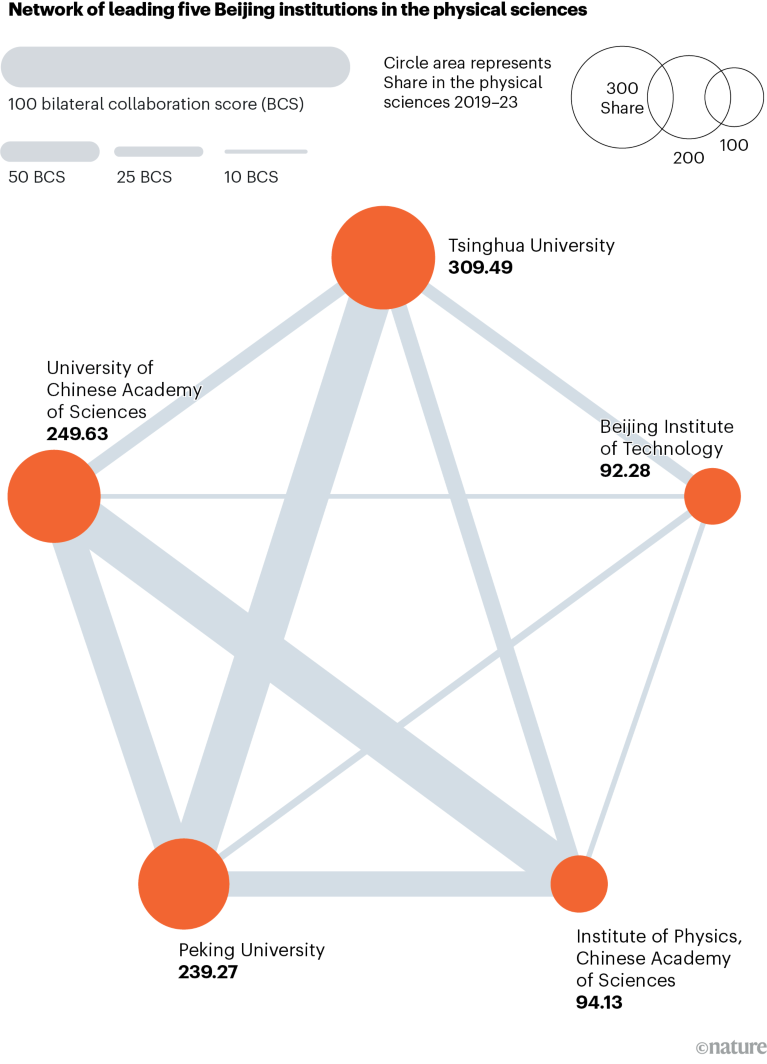
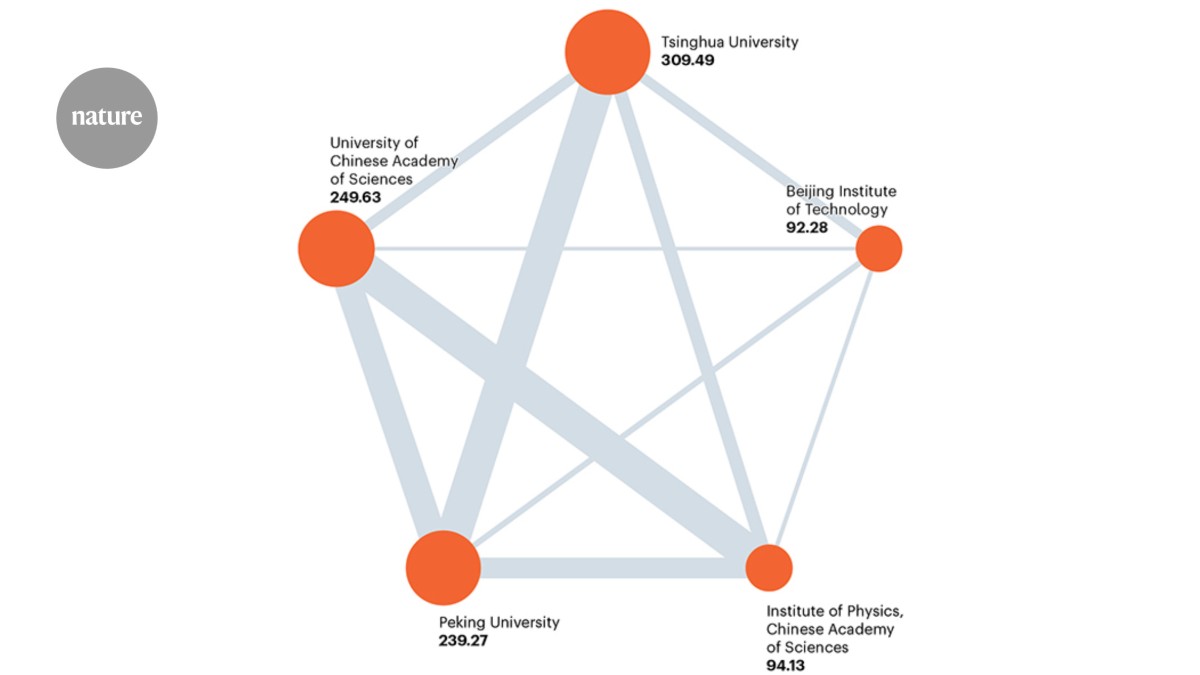
Beijing’s growth is partly a result of strengthening collaborations between research institutions and universities within the city. Two strong collaborations lead Beijing’s research cluster: the University of Chinese Academy of Sciences and the Institute of Physics, CAS; and Peking University and Tsinghua University.

Network chart showing collaboration in the physical sciences between the leading five institutions in Beijing for Nature Index research

Source: Nature Index; Data analysis: Aayush Kagathra; Data visualization: Tanner Maxwell and Simon Baker

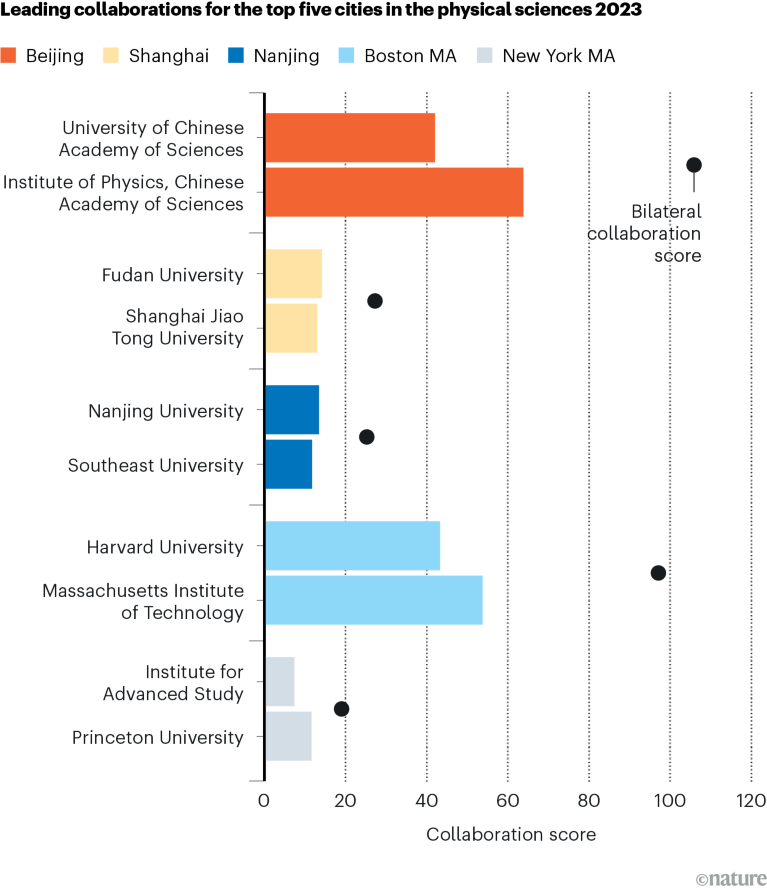
The partnership between the University of Chinese Academy of Sciences and Institute of Physics, CAS, also scores highly when compared with collaborations in other leading cities for physical sciences. It has a higher bilateral collaboration score (BCS), of 105.82, than the long-established partnership between Harvard University and the Massachusetts Institute of Technology (MIT), both located in the Boston metropolitan area (MA) in Massachusetts (BCS 97.04).

Boston and the New York City MA have often had relatively similar Shares for their physical-science output in the Nature Index. However, this year has brought a shift, with New York experiencing a 9.5% decrease in its adjusted Share, causing it to fall below its US counterpart on the leading cities list. The strong ties between Harvard and MIT might have contributed to Boston’s slight increase in its year-on-year Share, with the collaboration far exceeding that of the leading partnership in the New York MA, between the Institute for Advanced Study and Princeton University.

Bar chart showing the leading collaborations in Nature Index research in each of the five leading cities in the physical sciences in 2023

Source: Nature Index; Data analysis: Aayush Kagathra; Data visualization: Tanner Maxwell and Simon Baker


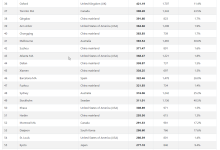
Leading 200 science cities

The leading 200 science cities and metropolitan areas ranked by article Share (Share) in 2023. Also listed are each city’s article count (Count) in 2023, and it's contribution to the location’s total Share of the year.

搜狗截图20241121104957.png搜狗截图20241121105040.png搜狗截图20241121105101.png搜狗截图20241121105138.png
 
Proud of Beijing, the world science, technology and innovation development center.

jcr_content.jpg
 

China has half of top 20 science cities: Nature Index

Source: Xinhua
2024-11-21 21:06:18

BEIJING, Nov. 21 (Xinhua) -- Half of the top 20 science cities are now in China, according to the Nature Index 2024 Science Cities, a supplement to Nature, released in Beijing on Thursday.

During a forum themed on sci-tech innovation hubs and science cities, Springer Nature issued the supplement acknowledging that Beijing leads the cities. Shanghai now takes second place, pushing New York into third.

The Nature Index showed that Beijing has remained the world's top science city since 2016. Meanwhile, Chinese cities, especially provincial capitals such as Nanjing, Wuhan, Hangzhou, Hefei and Xi'an, have greatly enhanced their position as globally competitive science centers.

The Nature Index noted that many of these rapidly developing cities are playing a specialist role in key technology areas such as electric vehicles and solar energy.

According to the supplement, there is evident progress in the health sciences, an area where Chinese cities still lag behind their Western counterparts.

The Nature Index data showed that although Beijing and Shanghai have maintained a clear lead, the growth in chemistry output from some of China's smaller cities could mark them as future contenders in this field.

In physical sciences, the eastern city of Nanjing climbed above Boston and New York for the first time to reach third place.

With its continued focus on sustainability and ecological protection, China is cementing itself as a leader in Earth and environmental sciences, according to the Nature Index. Beijing, Nanjing and Guangzhou are the three leading cities in the subject. ■


Users who are viewing this thread

Pakistan Defence Latest

Latest Posts

Back
Top